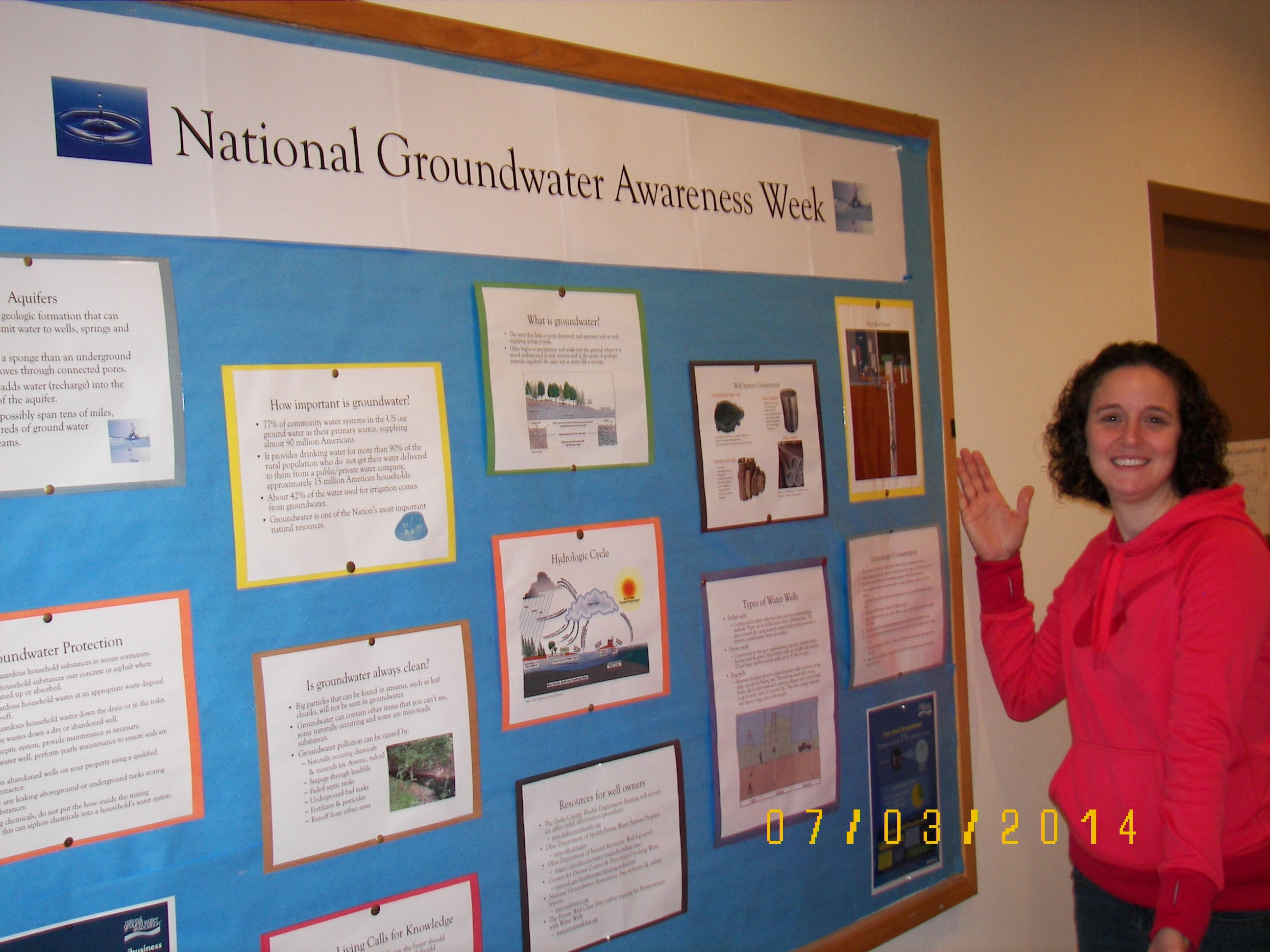
Started by the National Ground Water Association, Groundwater Awareness
Week is in its 16th year.
National Groundwater Awareness Week, March 9-15, 2014,
is a good time for the owners of household water wells to test the water
as managers of their own, personal drinking water system, said Terrence
L. Holman, DVM, Health Commissioner, at the Darke County Health
Department.
According to the Darke County Health Department, private well owners
should test their water annually for bacteria.
Additional tests the owner may wish to consider are a pre-screen
for nitrates, arsenic, and lead.
Well owners should check their water more often than annually if:
§
There is a change in the taste, odor, or appearance of the water
§
A problem occurs such as a broken well cap or a new contamination source
§
Family members or houseguests have recurrent incidents of
gastrointestinal illness
§
An infant is living in the home
§
There is a need to monitor the efficiency and performance of home water
treatment equipment.
The presence of coliform bacteria is a possible indicator of a well’s
susceptibility to contamination from animal wastes. E. coli is bacteria
that originate in wastes such as those found in sewage, and it can
result in severe illness. Its presence suggests a contamination source
such as a poor performing home septic system in the vicinity of the
well. If coliform bacteria
show up in a water test, some laboratories automatically test for
e-coli.
In the vast majority of cases, nitrates come from farm or industrial
contamination, or septic systems, and they can be dangerous to your
health. The presence of nitrates in well water could be an indication of
a local source of contamination or regionally contaminated groundwater.
Arsenic and Lead are also two elements of water quality that can be a
concern. Arsenic can be naturally occurring in an aquifer. Arsenic is a
semi-metallic element that occurs in rocks and soils—and water that
comes into contact with these rocks and soils. Lead does not occur
naturally in an aquifer and is usually due to a contamination source.
Should any contaminants above levels of health concern remain after
proper cleaning and disinfection of the water well system, a qualified
water well system professional can advise you on treatment options. It
is important to compare your drinking water lab test results to the
treatment capabilities of any recommended treatment system.
The Darke County Health Department offers water
testing on Thursday afternoons and Friday morning. Cost depends upon the
parameters to be tested.
Applications are available at the Health Department office or at
Water application
. For additional information contact Elizabeth Farver, water program
sanitarian at the Darke County Health Department at 937-548-4196 ext.
233. The Darke County Health Department office is open Monday through
Friday,
If testing privately, there is a new water quality
interpretation tool for private well owners located at
http://ohiowatersheds.osu.edu. The purpose of the
tool is to help private well owners who have water sampled from their
well understand the lab results and what actions they should take if
necessary. Water sample results from a lab sheet are entered into
the tool and with one click, well owners are provided with the standard
for the parameter of interest, the natural range in ground water in